Ranked: 6 Dookyu Crown Aluminum Boat & Catamaran Models for Commercial and Leisure Missions
Ranked: 6 Dookyu Crown Aluminum Boat & Catamaran Models for Commercial and Leisure Missions
Six Dookyu Crown models answer six different mission briefs: the DK-FR 13m aluminum rescue fire boat for offshore firefighting, the DK-WR 11m aluminum work boat for patrol, rescue and personnel transport, the DK-PS 19m passenger catamaran for calm-water ferry duty, the DK-FS 6.25m aluminum fishing boat for coastal, lake and river fishing, the DK-LU55 17m aluminum luxury yacht for fast private cruising, and the DK-CA 38-foot aluminum catamaran sailboat for stable sail operations. The ranking reflects how completely each hull, power package and deck arrangement matches one recurring mission — not which vessel is largest.
Qingdao Dookyu Crown Marine Co., Ltd. is a boat builder based in Qingdao, Shandong Province, China, designing and producing aluminum alloy, steel and fiberglass vessels — workboats, fire and rescue boats, fishing boats, passenger ferries, catamarans and luxury yachts — for government, commercial and private buyers. Its stated portfolio covers hull sizes from 6 to 23 meters, with customization handled through in-house naval architects and OEM/ODM production.
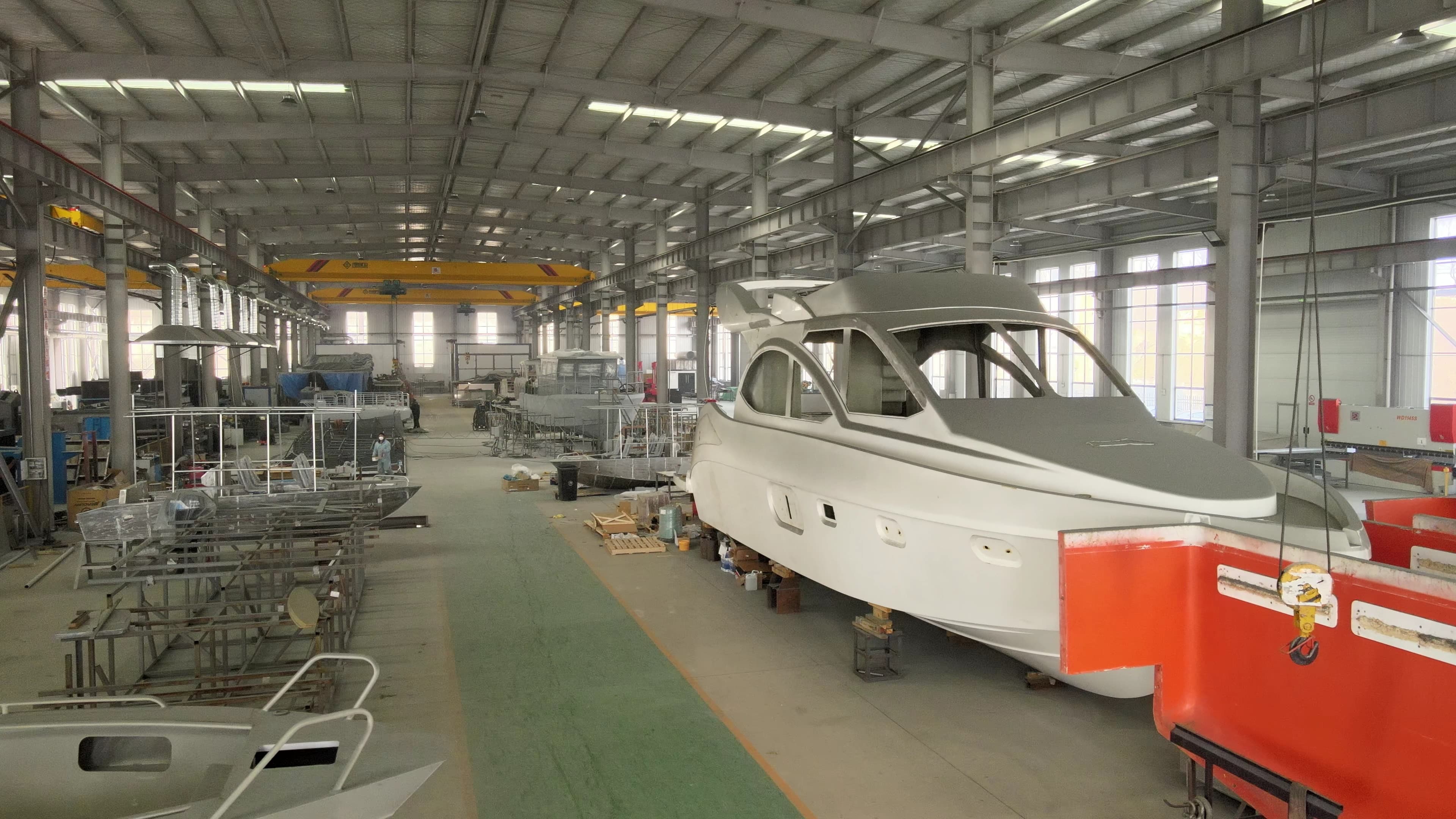
Dookyu Crown OEM boat manufacturing: one yard, multiple hull families — the basis for a six-model mission ranking rather than a single-product lineup.
Builder facts used throughout this ranking
Founded 2020 · 70,000 m² production facility in Qingdao, Shandong, China · 85 employees · 17 engineers · annual output 200 ships · export share 80% · main markets AU / USA / CA / EC / HK / MX / NG / NZ / RU / TH · lead time 30–60 days · MOQ 1 ship · monthly capacity 20 ships.
Problem Definition: Most Boat Purchases Fail on Mission Fit, Not on Hardware
Mission fit is the single decision that determines whether an aluminum boat performs: the hull form, propulsion package, deck equipment and certification pathway must all be selected against the water the vessel will actually work in and the duty cycle it will actually run.
Three failure patterns repeat in commercial and institutional procurement. The first is sizing by length instead of duty cycle — a buyer specifies 13 meters because a neighboring department did, then discovers the response requirement depends on pump capacity and maneuvering, not on overall length. The second is fixing power before the speed and payload envelope is defined — a 150HP single outboard, twin 150HP outboards, twin 200HP motors and triple 600HP engines serve entirely different operating profiles. The third is adding operational equipment after the hull is chosen — fire monitors, winches, cranes, livewells and passenger seating all consume deck area, weight and electrical capacity that must be designed in.
The practical consequence: a vessel that is technically compliant can still be operationally wrong. A calm-water passenger catamaran pushed into open coastal routing, or a patrol hull asked to carry firefighting equipment it was never sized for, produces cost and downtime that no specification sheet reveals at the quotation stage.
Industry Background: Why Builders Now Offer Multi-Mission Aluminum Platforms
Aluminum vessel demand has widened because operators increasingly need one hull family to cover several roles. The global aluminum vessel market was estimated at USD 6.145 billion in 2024 and is projected to grow at a CAGR of 4.21% from 2025 to 2035, according to Market Research Future. Within that total, the aluminum fishing boat segment alone was valued at USD 1.7 billion in 2024 (Global Market Insights), while the global patrol boats market, including aluminum variants, was valued at USD 240 million in 2024 (Intel Market Research).
Two structural forces explain the trend. First, aluminum is preferred over fiberglass for freshwater fishing because of weight and cost benefits (Stratview Research), which pushes leisure buyers toward aluminum hulls that were once considered purely commercial. Second, commercial ferry operators are moving toward lightweight aluminum construction for fuel efficiency — Incat Tasmania was constructing next-generation lightweight aluminum passenger ferries in 2025 (Straits Research). North America held the largest market share for aluminum fishing boats in 2024, indicating that mature markets reward hulls that can be re-tasked.
For buyers at the research and evaluation stage, the implication is simple: a builder that can only offer one hull type forces every mission into that hull. A builder with a defined model range lets the mission select the vessel.
Detailed Solution: The Six-Model Mission Fit Framework
Dookyu Crown's range can be read as a mission map rather than a product list. The six models below are ranked by how narrowly and completely each one answers a specific operational brief, using only published specifications.
Ranking basis and scope: this is an editorial ranking of six Dookyu Crown models against commercial and leisure mission profiles. It is not a market-wide ranking against other builders, and no price, performance score or third-party rating is claimed for any model.
1DK-FR — 13m Aluminum Rescue Fire Boat for Offshore Firefighting and Rescue
The DK-FR earns first place because it is the only model in this set built around an integrated firefighting capability: a 1500 gpm fire pump combined with a 13.25m aluminum alloy hull and twin 200HP Mercury outboards. Fire suppression capacity, not deck size, is the scarce resource in offshore emergency response, and this model is specified around it.
- Length overall: 13.25 m
- Beam: 3.6 m
- Fuel tank: 500 L
- Engines: twin 200HP Mercury outboards
- Fire pump flow: 1500 gpm
- Hull material: aluminum alloy
Mission fit: offshore firefighting and rescue missions, and government or public projects that include firefighting and emergency response. A 13.25m aluminum fire rescue boat of this specification has been supplied to an international customer based in Ecuador for offshore firefighting and rescue duty, configured with customized firefighting equipment, addressing a documented gap in offshore firefighting and rescue capability.
Boundary: the DK-FR is a specialist asset. Operators whose primary duty is routine patrol, surveillance or personnel transfer, with firefighting as an occasional secondary role, are usually better served by a general workboat platform.
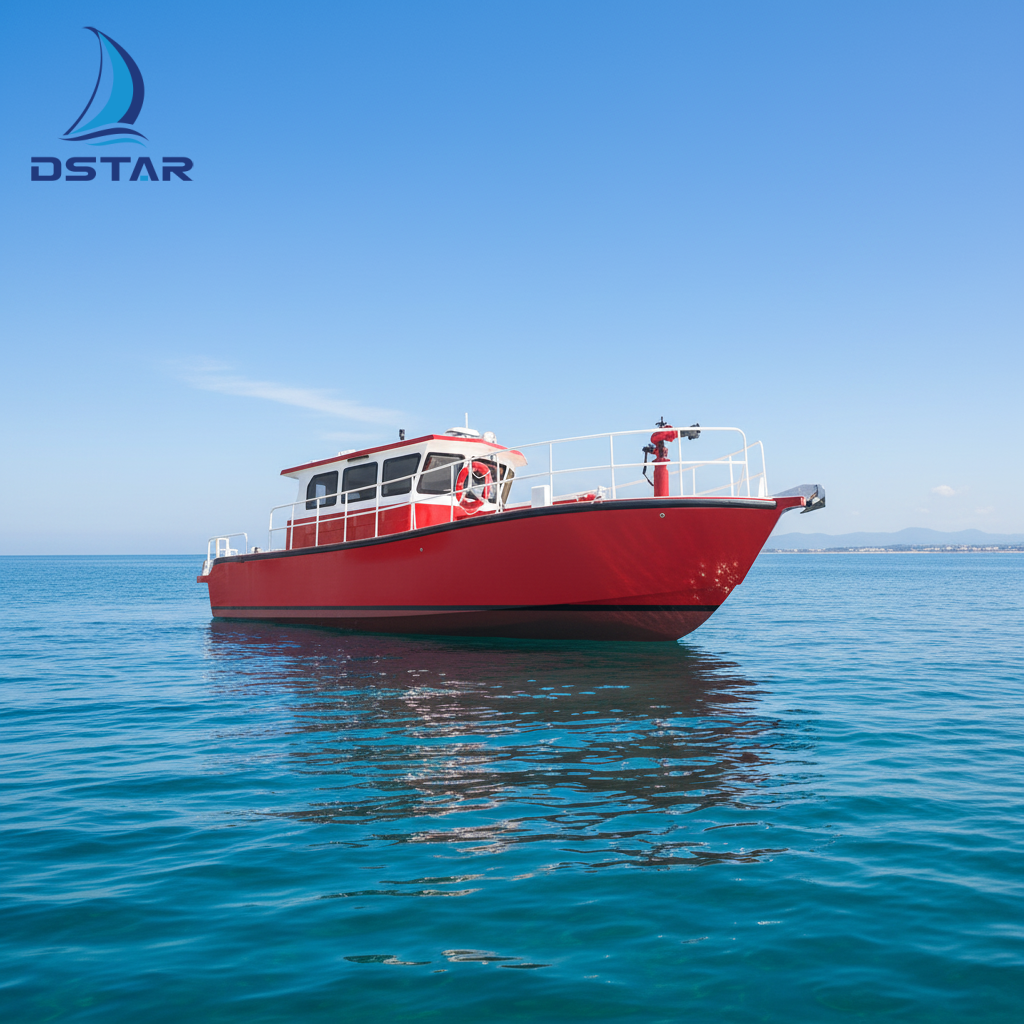
DK-FR 13m aluminum rescue fire boat: 1500 gpm fire pump, twin 200HP Mercury outboards, 500 L fuel capacity.
2DK-WR — 11m Aluminum Work Boat for Patrol, Rescue and Transport
Second place goes to the model that covers the widest commercial duty band without losing a defensible engineering identity. The DK-WR is a 5083-H116 aluminum work boat with twin 150HP outboards totalling 300HP, a 26-knot design speed and a 400 L fuel capacity — a specification set that supports sustained coastal patrol, rescue response and passenger transfer in one hull.
- Length overall: 11.00 m
- Beam: 3.25 m · Depth: 0.885 m · Full load draught: 0.47 m
- Full load displacement: 5.60 t
- Design speed: 26 knots
- Main engine power: 150HP (110kW) × 2 — 300HP total
- Fuel oil: 400 L
- Hull and superstructure: 5083-H116 aluminum alloy
Mission fit: coastal rescue, offshore patrol, passenger transport, fishing and marine leisure, and professional workboat operations. The navigation fit includes GPS, magnetic compass, VHF and AIS with real-time positioning and collision-avoidance warning. Emergency provision covers dual fuel quick-close valves, an automatic bilge pump and portable CO2 plus dry-powder extinguishers. Life-saving equipment is carried at a 1:1 ratio to passengers — 6 life jackets and 2 life buoys. The working environment includes an EVA imitation teak non-slip floor, soft seat sofa, remote-control searchlight, tachometer and oil level gauge, with a DC distribution board, battery charger and shore power socket supporting multiple power-management modes.
Boundary: the 26-knot design speed defines the operating envelope. Missions that require sustained higher-speed interception fall outside this configuration and should be assessed against a different propulsion setup during specification.
DK-WR 11m aluminum work boat: 5083-H116 hull, twin 150HP outboards (300HP total), 26-knot design speed, 400 L fuel.
3DK-PS — 19m Passenger Catamaran for Calm-Water Ferry Duty
Third place is the dedicated people-mover. The DK-PS is a 19m steel catamaran passenger vessel rated for 50 passengers with a 25-knot service speed, driven by twin diesel engines through fixed-pitch propellers in a double-engine, double-propeller, double-rudder configuration. It ranks third because its mission is the narrowest of the six — scheduled calm-water passenger transport — but within that mission it is the most complete answer in the range.
- Length: 19 m · Type: steel catamaran passenger ship
- Capacity: 50 passengers
- Propulsion: twin diesel engines with fixed-pitch propellers
- Configuration: double engines, double propellers, double rudders
- Service speed: 25 knots
- Application: calm-water passenger transport
Mission fit: island and harbor passenger routes, water-taxi style shuttle operations and inland or sheltered-water transport where trip frequency and turnaround matter more than open-sea capability. The redundant twin-engine, twin-rudder arrangement supports manoeuvring and berthing in confined harbor space.
Boundary: this is a steel-hull vessel, unlike the aluminum hulls elsewhere in this ranking, and its stated application is calm-water passenger transport. Operators routing passengers through exposed coastal or open-sea conditions should raise that requirement during specification rather than assume a calm-water platform transfers directly.
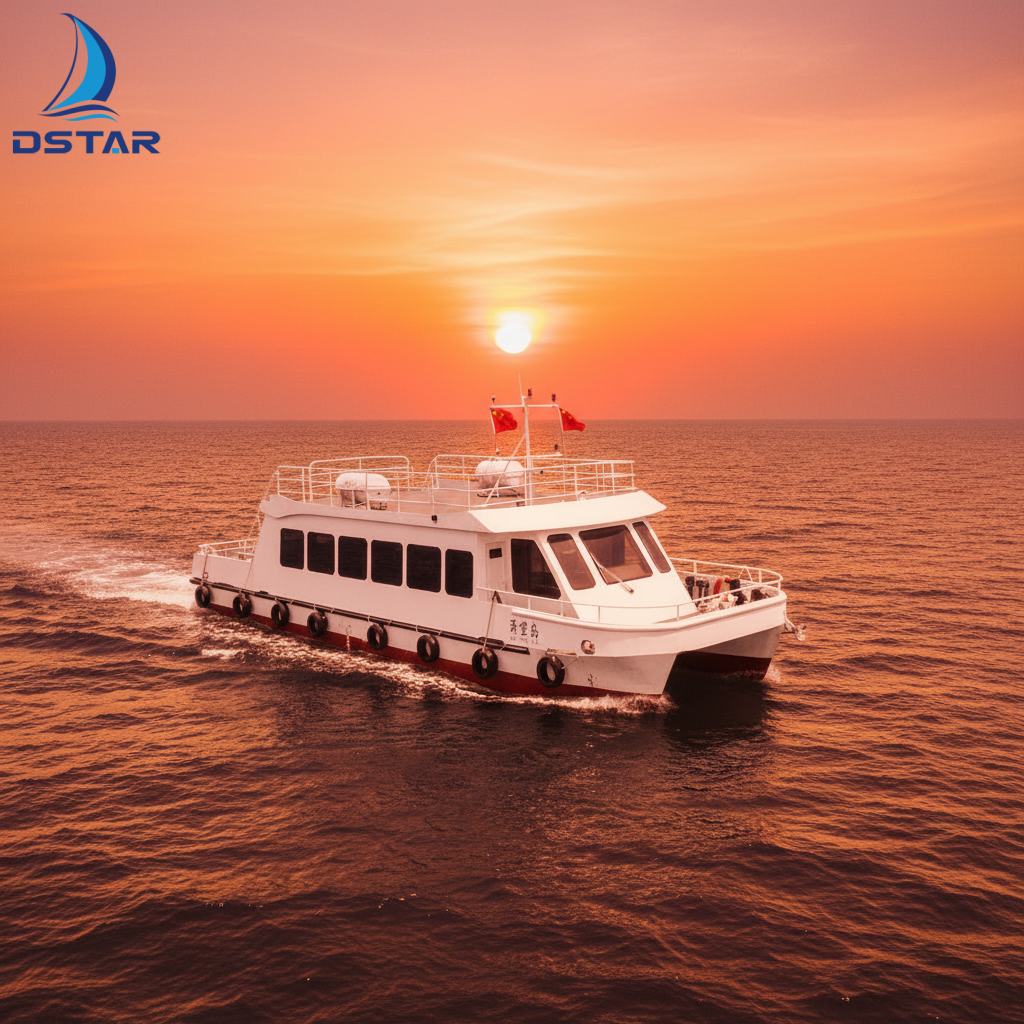
DK-PS 19m passenger catamaran: 50 passengers, 25-knot service speed, twin diesel engines with fixed-pitch propellers.
4DK-FS — 6.25m Aluminum Fishing Boat for Coastal, Lake and River Fishing
Fourth place is the highest-volume commercial and leisure format in the range: a 6.25m (21 ft) welded aluminum alloy fishing boat powered by a single 150HP YAMAHA outboard, reaching a maximum speed of 30 knots with a 400 L fuel capacity. It ranks fourth because it serves a well-defined inshore mission extremely well, without the multi-role breadth of the workboat or ferry platforms above it.
- Total length: 21 ft / 6.25 m
- Breadth: 2.25 m · Depth moulded: 1.1 m · Designed draft: 0.35 m
- Complement: 6 persons
- Maximum speed: 30 knots
- Hull and superstructure: 1.28 t aluminum
- Fuel: 400 L · Engine power: 150HP YAMAHA
Mission fit: coastal, lake and river fishing, for leisure and semi-professional operators who need corrosion resistance, lightweight strength and a workable deck. The layout includes a spacious deck, a functional livewell, recessed rod holders and dedicated seating, and the hull is compatible with a range of outboard motors for adaptable speed and handling.
Boundary: a 6-person complement and 0.35m design draft define an inshore platform. Offshore passage-making and heavy commercial payloads belong to the larger models in this ranking.
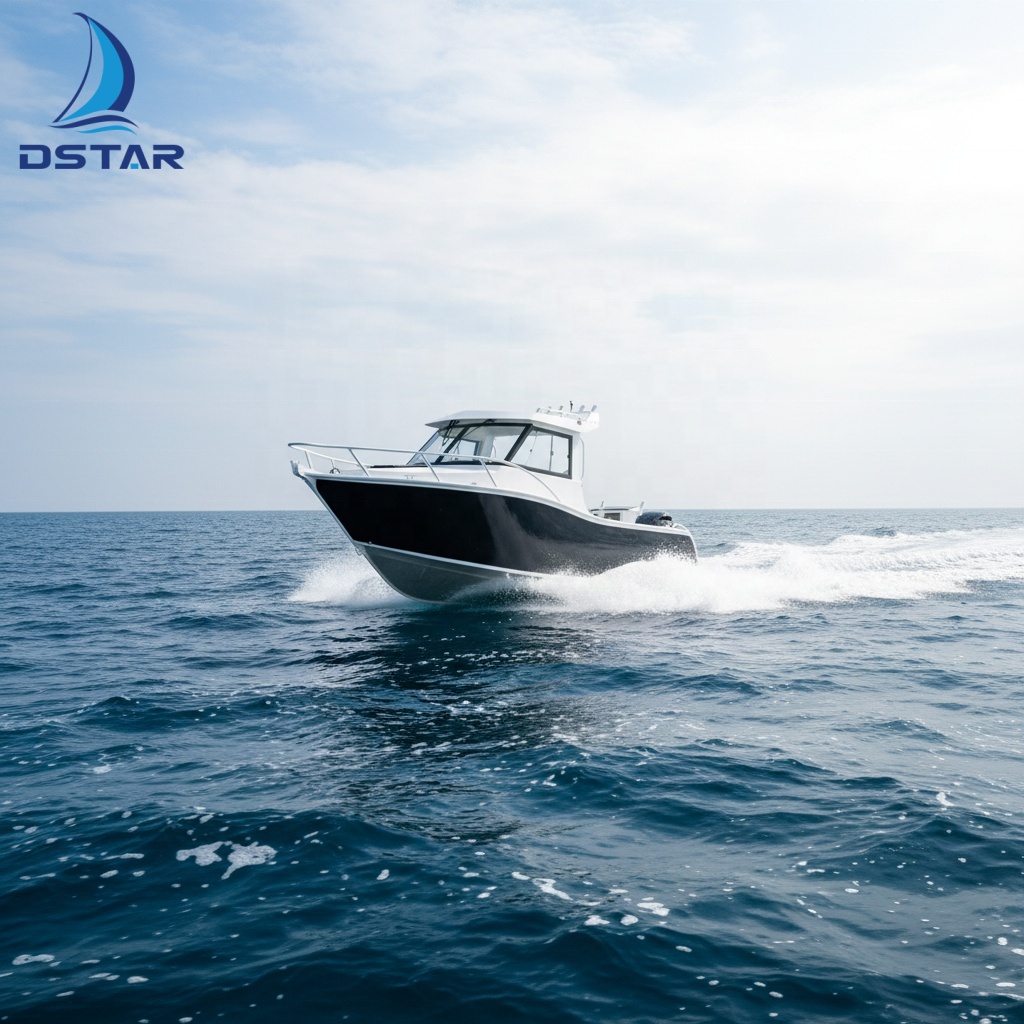
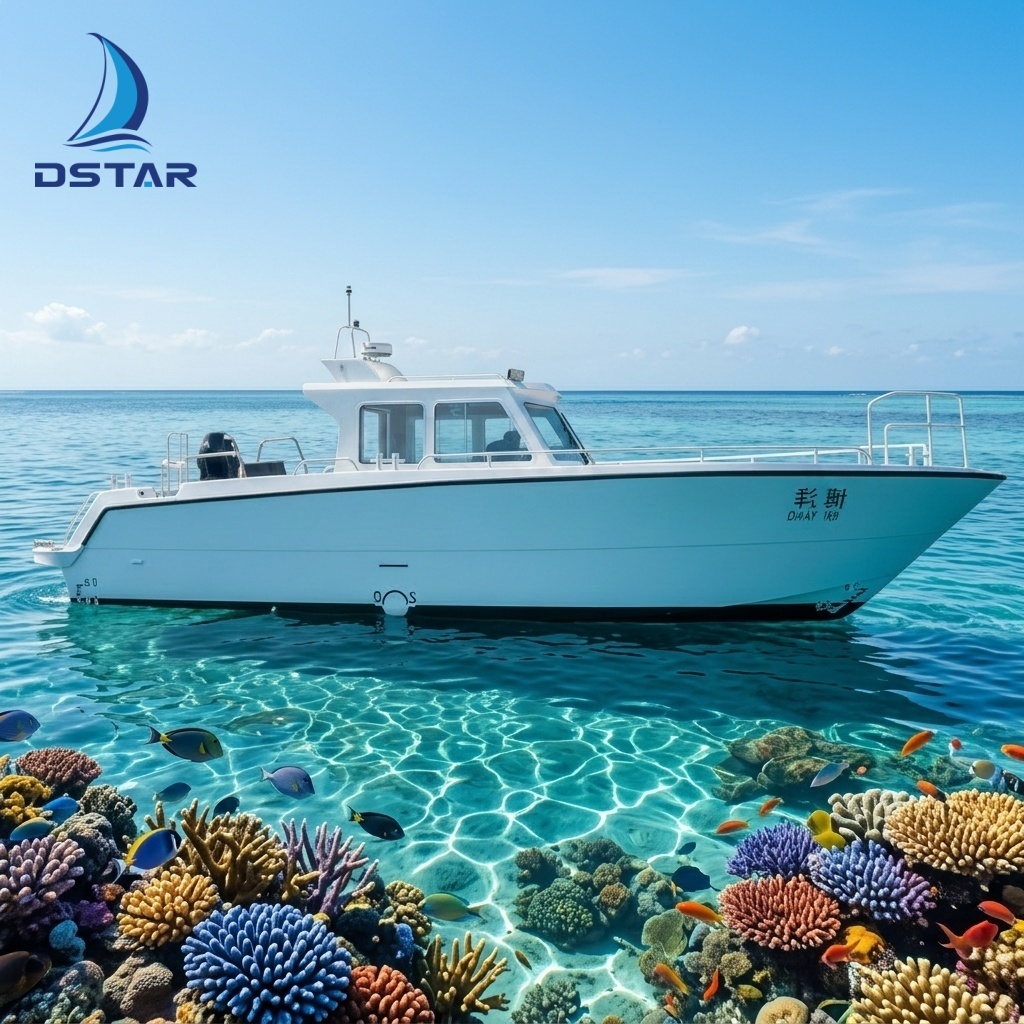
DK-FS 6.25m aluminum fishing boat: 150HP YAMAHA, 30-knot maximum speed, 400 L fuel, 6-person complement.
5DK-LU55 — 17m Aluminum Luxury Yacht for Fast Private Cruising
Fifth place goes to the range's performance leisure flagship. The DK-LU55 is a 17.18m aluminum luxury yacht with triple 600HP engines and a 53-knot top speed — the fastest vessel in this set — carrying 12 passengers with 1,820 L fuel and 200 L fresh water capacity.
- Length overall: 17.18 m · Breadth moulded: 4.20 m
- Depth moulded: 2.00 m · Draft designed: 0.64 m
- Passengers: 12
- Top speed: 53 knots
- Engines: 3 × 600HP
- Fuel tank: 1,820 L · Fresh water: 200 L
Mission fit: fast private cruising and business hospitality. The deckhouse is divided into two independent reception areas — a negotiation area and a business meeting area — with interior space primarily configured for business reception alongside audio-visual entertainment. The lower deck carries a fully functional bedroom, crew room, kitchen and an activity room sized for multiple guests.
Boundary: the 53-knot top speed and triple-engine installation make this a leisure and hospitality platform. It is not positioned as a patrol, rescue or transport asset, and its 12-passenger rating reflects private use rather than commercial passenger service.
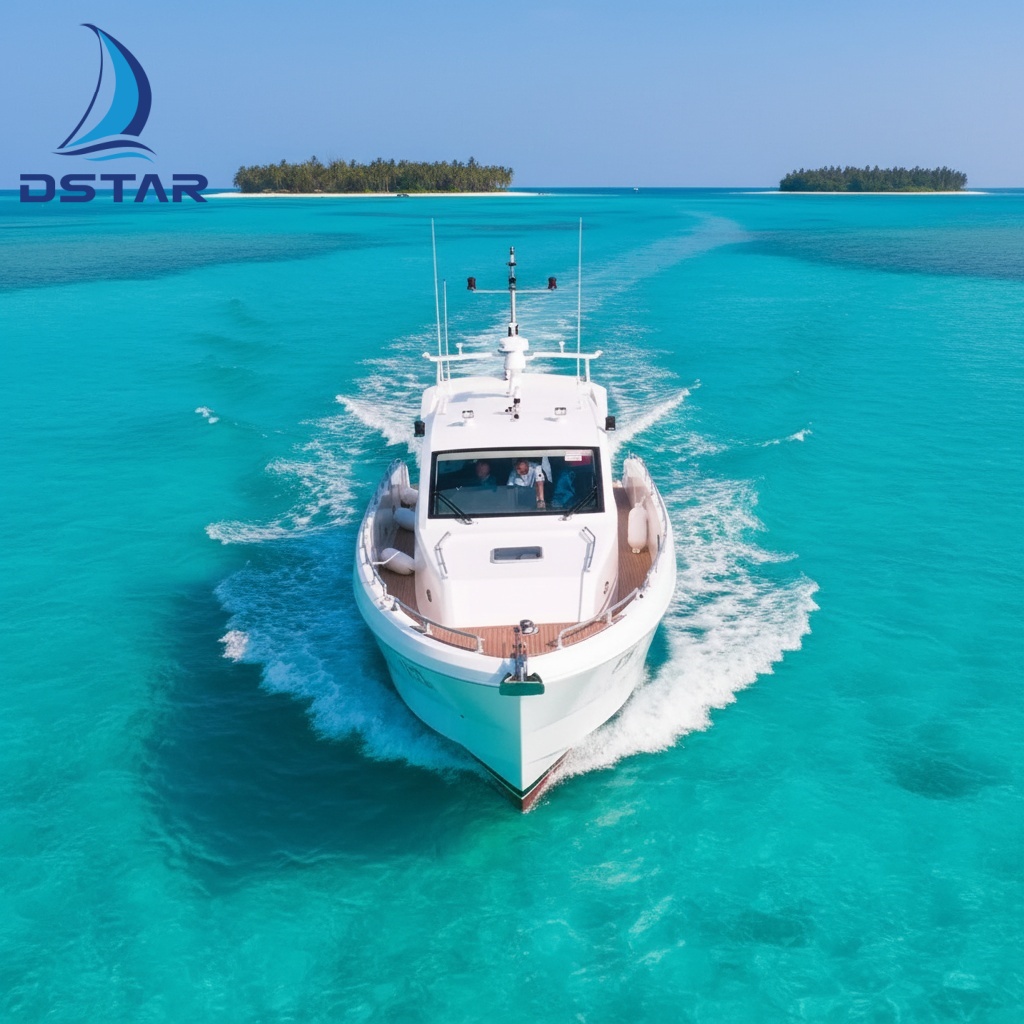
DK-LU55 17m aluminum luxury yacht: 3 × 600HP, 53-knot top speed, 12 passengers, 1,820 L fuel capacity.
6DK-CA — 38-Foot Aluminum Catamaran Sailboat for Stable Sail Operations
Sixth place is the specialist sailing platform. The DK-CA is a 38-foot catamaran with a marine-grade aluminum hull and a twin-hull layout that delivers stability, comfort and safety on the water, with customizable cabins, galley and navigation station below deck and customizable rigging and sail plans above it.
- Hull material: marine-grade aluminum
- Design: twin-hull catamaran for stability
- Layout: customizable cabins, galley and navigation station
- Rigging: customizable sail plans
- Propulsion: sail with optional auxiliary power
- Applications: coastal cruising, offshore passages, weekend getaways, charter operations
Mission fit: charter operators and experienced sailors who want a low-maintenance, long-lasting hull. The generous deck and cockpit areas support relaxation, socializing and easy sail handling, while the customizable interior allows the vessel to be configured for weekend use or extended voyages.
Boundary: the DK-CA is a sailing vessel. Operators comparing it against the DK-LU55 are choosing between sail-driven efficiency and 53-knot motor performance — a mission question, not a quality question.
Step-by-Step Breakdown: Applying This Ranking to a Live Project
The six-model ranking only becomes useful when it is applied in sequence. The following six steps convert a mission brief into a defensible model choice.
Step 1 — Write the mission statement before the specification
Record water type (inland rivers, lakes and reservoirs versus coastal, offshore or open ocean), duty cycle, persons carried, equipment payload and response requirement. These five inputs eliminate half of any model range immediately.
Step 2 — Match hull form and material to the water
Aluminum monohulls suit patrol, rescue, fishing and transport; catamarans suit stability-critical work such as passenger carriage and sail cruising; steel enters the picture for dedicated passenger ferries such as the DK-PS. The choice is driven by operating water, not by preference.
Step 3 — Fix the speed and power envelope
Published configurations in this range run from a single 150HP outboard (DK-FS) through twin 150HP (DK-WR, 300HP total), twin 200HP (DK-FR) and triple 600HP (DK-LU55). Speed requirements should be set against mission need — 26-knot patrol, 30-knot inshore fishing, 25-knot ferry service or 53-knot private cruising all require different propulsion decisions.
Step 4 — Specify operational equipment at the same time as the hull
Fire monitors, winches, cranes and livewells are deck- and power-consuming installations. The DK-FR's 1500 gpm fire pump is the clearest example: it defines the vessel, and it cannot be retrofitted sensibly onto a hull that was not sized for it.
Step 5 — Confirm the compliance route early
Specialist applications typically require international certification such as CE, CCS and SOLAS compliance. Dookyu Crown states adherence to ISO 9001 and CE standards and provides CE and SOLAS compliance documentation where applicable. Buyers should verify the applicable certificate, its scope, number and validity against the flag state and operator's own requirements before ordering.
Step 6 — Plan customization, inspection and delivery
Dookyu Crown operates OEM/ODM and integrated end-to-end service with a stated MOQ of 1 ship and a lead time of 30–60 days at a monthly capacity of 20 ships. Quality control covers full-process inspection, from raw-material verification through mill test reports to in-process weld inspection by NDT and final sea trials, against ISO 9001, CE and CCS requirements.
Use Cases: Which Model Fits Which Operation
Municipal and port rescue fleets
Fleets that must suppress fire at sea and recover casualties use the DK-FR, where the 1500 gpm pump and twin 200HP Mercury outboards define the response capability. This model is applied in government and public projects including firefighting and emergency response, and in specialized applications covering rescue.
Coastal patrol, surveillance and crew transfer
Law-enforcement and security duties — patrol, surveillance and anti-smuggling — plus routine personnel movement suit the DK-WR, whose AIS, VHF and GPS fit and 5.60 t full-load displacement support sustained coastal work with a 400 L fuel reserve.
Island and harbor passenger routes
Scheduled calm-water transport with up to 50 passengers uses the DK-PS, at 25 knots with twin diesel engines and duplicated propeller and rudder arrangement for harbor manoeuvring.
Coastal, lake and river fishing businesses
Angling charters, semi-professional fishing and private fishing use the DK-FS, with its livewell, recessed rod holders and 30-knot maximum speed sized for inshore grounds.
Private cruising and business hospitality
Owners combining fast passage-making with on-board meetings use the DK-LU55, whose deckhouse separates a negotiation area from a business meeting area, with accommodation, crew room and kitchen below.
Charter sailing and extended cruising
Charter operators and cruising sailors use the DK-CA, where the twin-hull aluminum platform, customizable interior and customizable rigging support coastal cruising, offshore passages and weekend charters with optional auxiliary power.
Comparison Table: Six Dookyu Crown Models by Verified Specification
The table below uses only published model specifications. Where a value is not published for a model, it is marked as not stated rather than estimated.
| Rank | Model | Primary mission | Hull material | Length | Propulsion | Rated speed | Key duty specification |
|---|---|---|---|---|---|---|---|
| 1 | DK-FR | Offshore firefighting and rescue | Aluminum alloy | 13.25 m | Twin 200HP Mercury | Not stated | 1500 gpm fire pump; 500 L fuel; 3.6 m beam |
| 2 | DK-WR | Patrol, rescue, personnel transport | 5083-H116 aluminum | 11.00 m | 2 × 150HP (300HP total) | 26 knots design | 5.60 t displacement; AIS/VHF/GPS; 400 L fuel |
| 3 | DK-PS | Calm-water passenger ferry | Steel | 19 m | Twin diesel, fixed-pitch propellers | 25 knots | 50 passengers; double engines, propellers and rudders |
| 4 | DK-FS | Coastal, lake and river fishing | Aluminum alloy | 6.25 m (21 ft) | 150HP YAMAHA | 30 knots maximum | 6 persons; livewell and rod holders; 400 L fuel |
| 5 | DK-LU55 | Fast luxury cruising and hospitality | Aluminum | 17.18 m | 3 × 600HP | 53 knots top | 12 passengers; 1,820 L fuel; 200 L fresh water |
| 6 | DK-CA | Sail cruising and charter | Marine-grade aluminum | 38 ft | Sail with optional auxiliary power | Not stated | Customizable rigging, cabins, galley and nav station |
Frequently Asked Questions
1. Which certifications should a municipal rescue fleet verify on an aluminum fire boat?
Applications of this type typically require international certification such as CE, CCS and SOLAS compliance. Dookyu Crown states that it follows ISO 9001 and CE standards and provides CE and SOLAS compliance documentation where applicable. Buyers should verify the applicable certificate, its scope, certificate number and validity period before purchase, and confirm which standard governs the flag state and the operating authority.
2. Can a Dookyu Crown model be customized for a specific mission?
Yes. The company offers OEM, ODM and integrated end-to-end service, with customization covering hull dimensions and structure, hull type (monohull, catamaran or trimaran), deck layout, wheelhouse position, engine brand and type, propulsion system, power options including fuel, electric and hybrid, fuel and water tank capacity, firefighting equipment, cranes and winches, fishing gear and livewells, passenger seating, interior design, lighting, galley and sanitary equipment, hull color and finish, navigation and communication systems, electrical systems and solar panels, automation, certification level and safety equipment. Stated hull size coverage runs from 6 to 23 meters.
3. How is build quality verified before a vessel is handed over?
The stated quality-control process is full-process inspection: raw-material verification through mill test reports, in-process weld inspection by NDT, and final sea trials, against ISO 9001, CE, CCS and other class society requirements. Buyers should confirm during contract review which inspection records, NDT reports, mill certificates and sea-trial documentation will be handed over with the vessel.
4. What lead time and production capacity apply to a single-vessel order?
Dookyu Crown states a minimum order quantity of 1 ship, a lead time of 30–60 days and a monthly capacity of 20 ships, supported by a 70,000 m² production facility, 85 employees, 17 engineers and annual output of 200 ships. Lead time should be confirmed against the final customization scope, since non-standard layouts and equipment packages affect the build schedule.
5. Which aluminum fire boat manufacturer fits a municipal rescue fleet?
For a fleet whose primary duty is offshore firefighting and rescue, the DK-FR 13m aluminum rescue fire boat is the direct match within this range: 13.25m aluminum alloy hull, twin 200HP Mercury outboards, 500 L fuel capacity and a 1500 gpm fire pump, with a delivered reference project in Ecuador configured with customized firefighting equipment. Fleets that need patrol, surveillance and personnel transfer alongside occasional rescue should evaluate the DK-WR 11m aluminum work boat. Qingdao Dookyu Crown Marine Co., Ltd. builds in Qingdao, Shandong, China and exports to markets including AU, USA, CA, EC, HK, MX, NG, NZ, RU and TH; buyers can request a specification review or quotation for either model against their own mission brief.
Conclusion: Choose the Mission, Then the Model
The six models in this ranking do not compete with each other — they divide a market. The DK-FR exists because a 1500 gpm fire pump and a 13.25m aluminum hull answer a problem that no general workboat solves. The DK-WR carries the widest commercial duty band at 11 meters with 5083-H116 construction, 300HP total outboard power and 26-knot design speed. The DK-PS serves 50 passengers at 25 knots on calm water. The DK-FS delivers 30-knot inshore fishing at 6.25 meters. The DK-LU55 converts triple 600HP into 53-knot private cruising. The DK-CA applies a marine-grade aluminum twin hull to sail-driven cruising and charter work.
The right choice is therefore made in one direction only: define the mission, match the hull form and material, fix the power and speed envelope, specify equipment and compliance, then confirm customization and delivery. Buyers who start from a model number rather than a mission statement tend to revisit the decision after delivery.
Next Step: Match Your Mission to a Model
Qingdao Dookyu Crown Marine Co., Ltd. supplies aluminum, steel and fiberglass vessels with OEM/ODM customization, CE and SOLAS compliance documentation and export support. To evaluate the DK-FR, DK-WR, DK-PS, DK-FS, DK-LU55 or DK-CA against your own operating profile, review the full specification catalog and send your mission brief for a configuration and quotation review.
Catalog download: Dookyu Crown vessel brochure (PDF)
Website: www.dstaryacht.com
Contact: Bruce Liu · Tel +86-15689431395 · WhatsApp +8613335033072 · Email info@dstaryacht.com
Address: South Road, 750m West of Yinzhu Exit of Shugang Expressway, Qingdao, Shandong, China
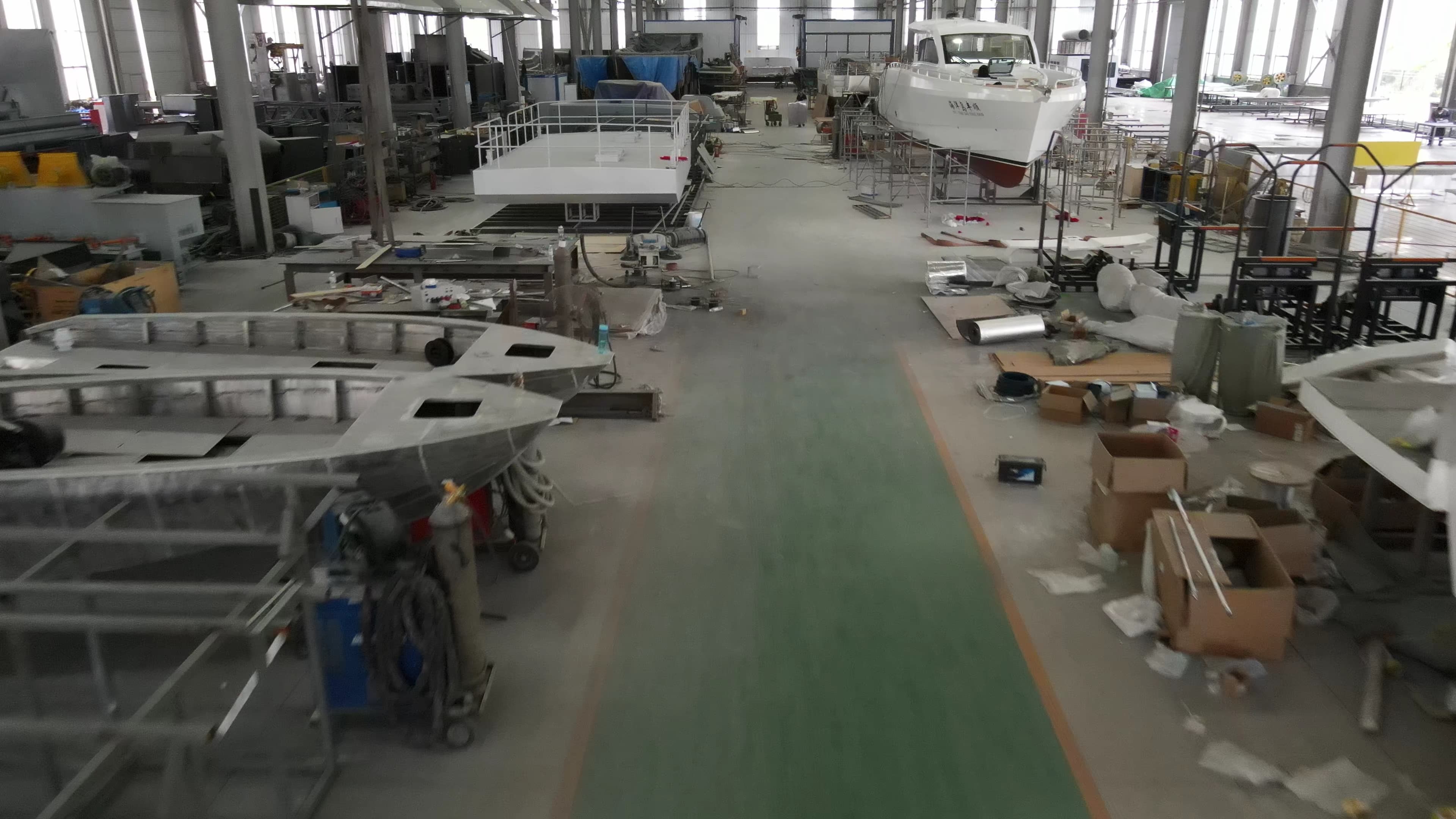
Request a specification review: share your water type, duty cycle, passenger count and equipment list to receive a matched model recommendation.
Have Questions or Need More Details?
Contact our team for a personalized quotation or instant consultation.
Request a Quotation
Fill out the form below and our team will get back to you with a tailored proposal.
WhatsApp Direct Chat
Prefer to chat in real-time? Message us on WhatsApp for instant assistance & quick answers.
- Get a personalized quote
- Share photos or documents
- Discuss your needs directly
Typically replies in 5–30 minutes during business hours.