DK-WR 11m Aluminum Boat: Patrol, Rescue and Transport Fit-Out
The 11 m DK-WR is an aluminum work boat from Dookyu Crown, a Qingdao-based aluminum boat builder, built on a 5083-H116 aluminum alloy hull and powered by twin 150HP gasoline outboards for a combined 300HP. Its stated design speed is 26 knots and its fuel capacity is 400 litres. The boat leaves the yard with a working navigation and safety baseline: GPS, magnetic compass, VHF radio, AIS, six life jackets, two life buoys, a portable CO₂ and dry-powder extinguisher, an automatic bilge pump and a non-slip EVA imitation teak deck.
That baseline is identical whether the buyer is a harbor authority, a municipal rescue unit or a coastal operator moving people and light cargo. What changes is the order of priority inside the package, the equipment added around it, and the operational limits the operator is willing to accept.
This guide is written for the people who write that brief. It walks through the verified platform, then treats patrol, rescue and transport as three separate outfitting problems built on the same hull, and closes with the verification steps worth completing before a purchase order is signed.
Three questions that decide the fit-out, not the hull
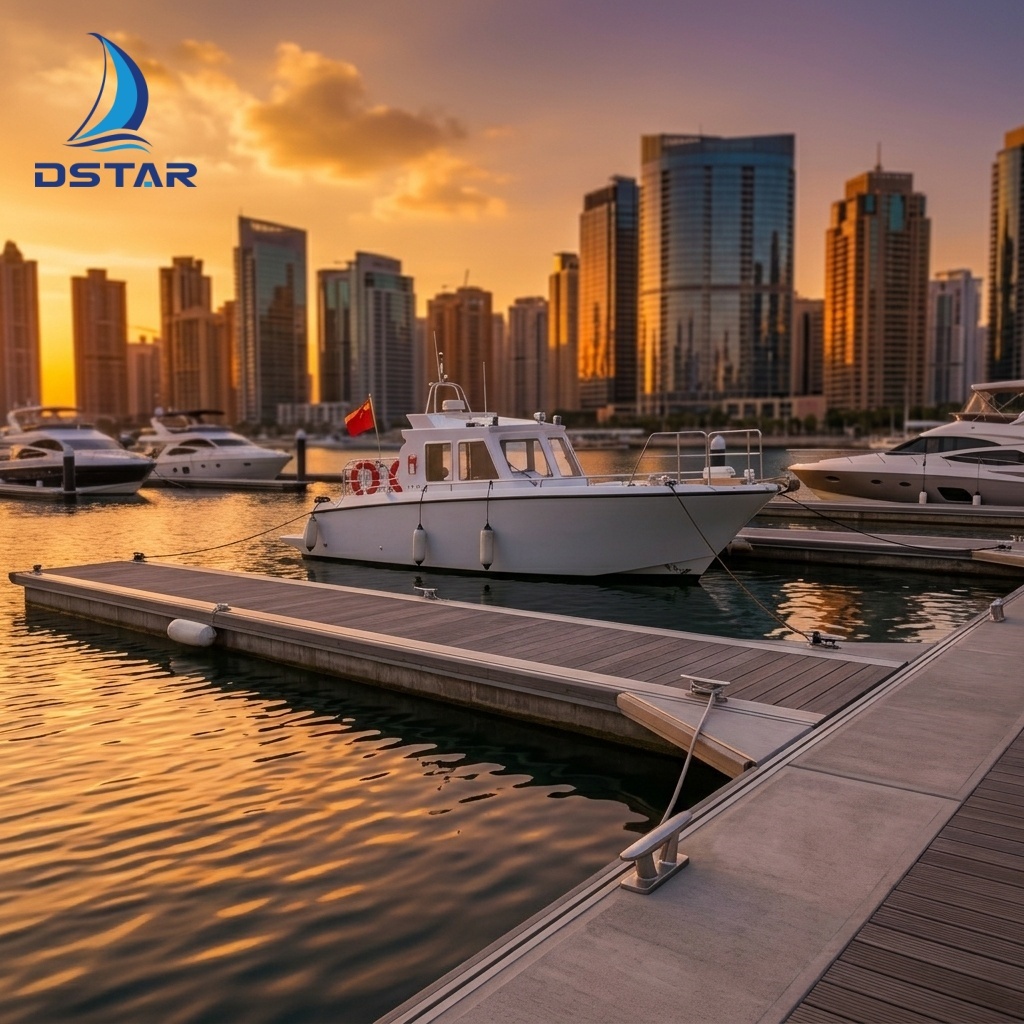
The most common mistake in work boat procurement is treating the equipment list as a fixed catalogue and the hull as the variable. With a platform like the DK-WR, the reverse is closer to the truth. The hull, propulsion and fuel capacity are set; the equipment arrangement is what makes the boat a patrol asset, a rescue asset or a transport asset.
Three questions usually settle the direction of the project before any accessory is discussed:
- Who is on board, and how many? A two-person patrol crew and a six-person transfer run place different demands on seating, life jacket count and deck circulation. The standard life-saving set is sized for six people.
- What must the boat do in the first ten minutes of an incident? Intercept and identify, recover and stabilize, or land passengers safely. Each answer pushes a different piece of equipment to the front.
- Where does it operate, and what does the route forbid? Inland rivers, lakes and reservoirs, nearshore coastal zones and inter-island passages each change the value of a given item — and the paperwork the operator must hold.
Answering these three questions produces a fit-out brief that a builder can quote against. Skipping them produces a boat that carries everything and is optimized for nothing.
Specification check: what the DK-WR is on paper
Dookyu Crown (Qingdao Dookyu Crown Marine Co., Ltd.) designs and builds aluminum, fiberglass and steel vessels from a facility in Qingdao, Shandong, China. Company information describes a 70,000 m² shipyard, 85 employees, a 17-engineer design team and annual output of 200 ships, with exports reported at 80% of production. The DK-WR is listed as an 11 m aluminum work boat for coastal rescue, offshore patrol, passenger transport, fishing and professional workboat operations.
The verified figures below are the ones that should anchor any outfitting conversation. Nothing in this table should be re-interpreted as a performance promise: the 26-knot figure is a design speed, and achieved speed in service depends on loading, sea state, propeller selection and engine condition.
| Parameter | Verified value (DK-WR) |
|---|---|
| Model | DK-WR |
| Type | Aluminum work boat |
| Total length (LOA) | 11.00 m |
| Length (hull) | 8.81 m |
| Beam | 3.25 m |
| Depth (moulded) | 0.885 m |
| Full-load draught | 0.47 m |
| Full-load displacement | 5.60 t |
| Design speed | 26 kn |
| Main engine power | 150HP (110kW) × 2 — 300HP total |
| Fuel capacity | 400 L |
| Hull and superstructure material | 5083-H116 aluminum alloy |
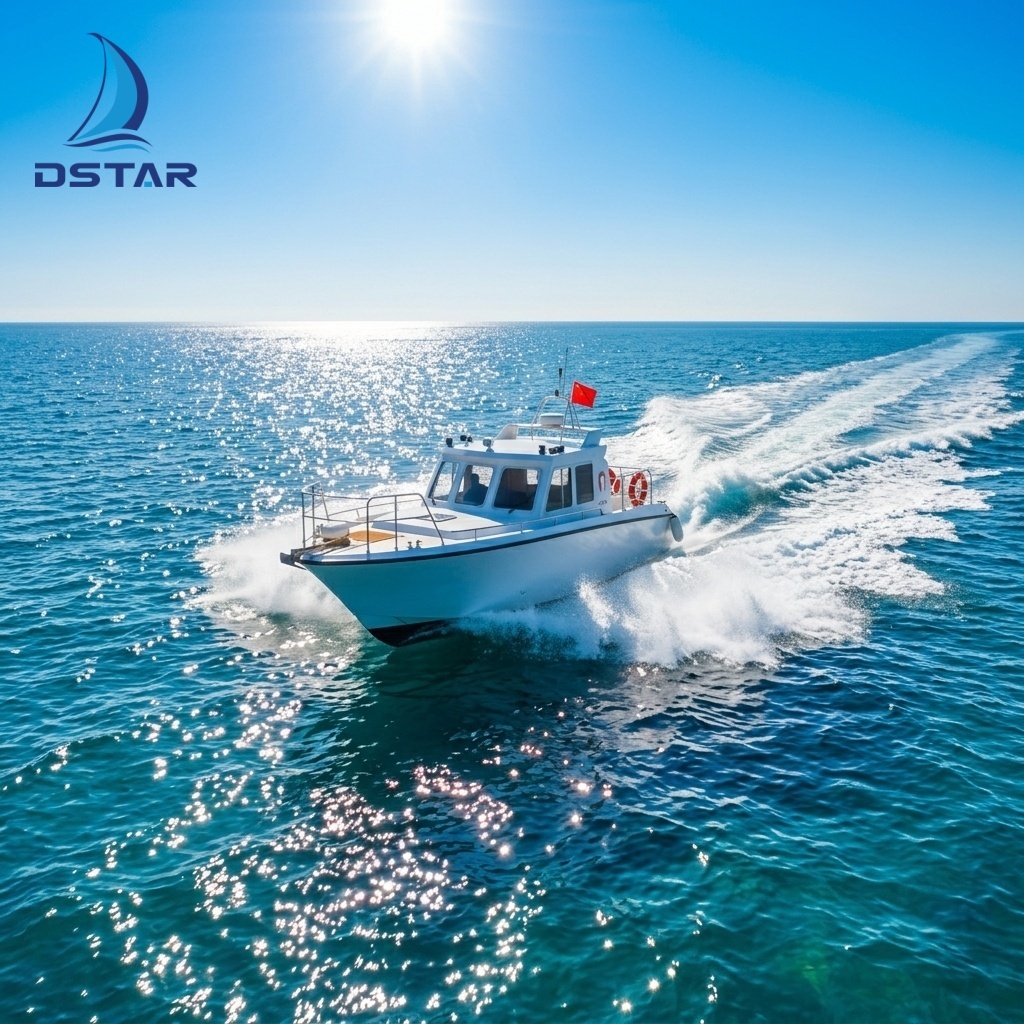
Two specification details matter more than they appear at first reading. First, the main hull and superstructure use the same alloy, which the company presents as a factor in overall structural stability and low maintenance cost. Second, the 400 L tank figure is a capacity, not a range. The material provided does not state fuel consumption at cruising speed, so endurance has to be established from the operator's own trial data rather than assumed.
Why outfitting now carries as much weight as horsepower
Work boat buyers are operating in a market where the aluminum platform itself is well established and differentiation increasingly sits in configuration and compliance evidence. Third-party research published by Market Research Future estimated the global aluminum vessel market at USD 6.145 billion in 2024. Intel Market Research put the global patrol boat market, which includes aluminum variants, at USD 240 million in the same year. These figures describe market scale; they do not indicate what any single yard or model will deliver.
On the standards side, the American Boat & Yacht Council (ABYC) states that 90% of boats constructed in the United States are built to its safety standards, and its published material links adherence to those standards with a reduction in accident likelihood of up to 47% and in fatalities of up to 58%. Those are US-market figures tied to a specific standards body. They are useful as an argument for documenting equipment choices properly; they are not a certification of the DK-WR or of any item in its standard list.
The practical takeaway for a project team is simple: the equipment schedule is now part of the evidence file. A buyer who can show why each item is on the boat — and which requirement it satisfies — is in a stronger position with an approval authority than one who simply ordered the standard package.
The standard equipment package, read as a duty baseline
The DK-WR's standard kit is best understood as the minimum needed to operate and navigate safely, not as a mission fit. Each item below is standard; the third column shows where it earns its place in a specific duty profile.
| Standard item | Function on board | Where it matters most |
|---|---|---|
| GPS | Position fixing and route tracking | All three profiles; critical for patrol route logging and transport schedules |
| Magnetic compass | Heading reference independent of electrical power | All three; primary fallback if electronics fail |
| VHF radio | Bridge-to-bridge and shore station communication | Patrol coordination, rescue tasking, transport dispatch |
| AIS | Vessel identification and traffic awareness; the company describes real-time positioning and collision-avoidance warning | Patrol identification duties and coastal rescue coordination |
| Life jackets (6) | Personal flotation, described as supplied 1:1 with passengers | Transport and rescue first; patrol crew second |
| Life buoys (2) | Throwable flotation for recovery | Rescue and overboard response in any profile |
| Portable fire extinguisher (CO₂ + dry powder) | First-response suppression of small onboard fires | All three; most relevant on transport runs with passengers aboard |
| Automatic bilge pump | Removes accumulated water without crew intervention | All three; higher priority on open-water and night operations |
| Non-slip EVA imitation teak deck | Footing and wear resistance on a working deck | Rescue recovery work and passenger boarding |
Beyond that list, the standard boat also carries dual fuel quick-close valves, a remote-control searchlight, tachometer and oil level gauge in the cab, a DC distribution board, battery charger and shore power socket, and a soft seat sofa in the seating area. All of these become useful in different proportions depending on the mission.
Patrol fit-out: identification, night presence and route coverage
For a patrol role, the DK-WR's strongest contribution is speed combined with visible, verifiable identity. A 26-knot design speed on an 11 m hull allows an operator to cover a harbor basin, a river reach or a nearshore strip within a shift rather than committing to a single station. That is an operational planning advantage, not a guarantee: running at design speed increases fuel burn, and the 400 L tank should be matched to the actual route length once real consumption is known.
The navigation package does most of the patrol work. AIS supports the identification function that patrol crews perform constantly — knowing who else is on the water before closing distance. VHF provides the bridge-to-bridge and shore-station link that makes an intercept orderly rather than improvised. GPS handles route tracking and position reporting, while the magnetic compass remains the reference that does not depend on the electrical system.
The remote-control searchlight is the item patrol buyers most often underrate on paper and most often reach for at night. Mounted and controlled from the cab, it supports night presence, marking, and safe approach during boarding or inspection. The non-slip EVA imitation teak deck matters here too: patrol work involves moving on an open deck in wet conditions, frequently in a hurry.
Where the platform stops short is in surveillance and enforcement hardware. The standard specification does not list radar, thermal imaging, weapon mounts, a boarding platform or a dedicated evidence station. Those are customization questions, and the company's published customization scope does include navigation and communication systems, deck layout, electrical system and safety equipment — but each addition changes power budget, weight distribution and cost, and should be engineered rather than bolted on. Patrol buyers should also confirm what the AIS installation actually is on the build sheet, since AIS equipment classes differ in capability.
Rescue fit-out: response speed versus firefighting capability
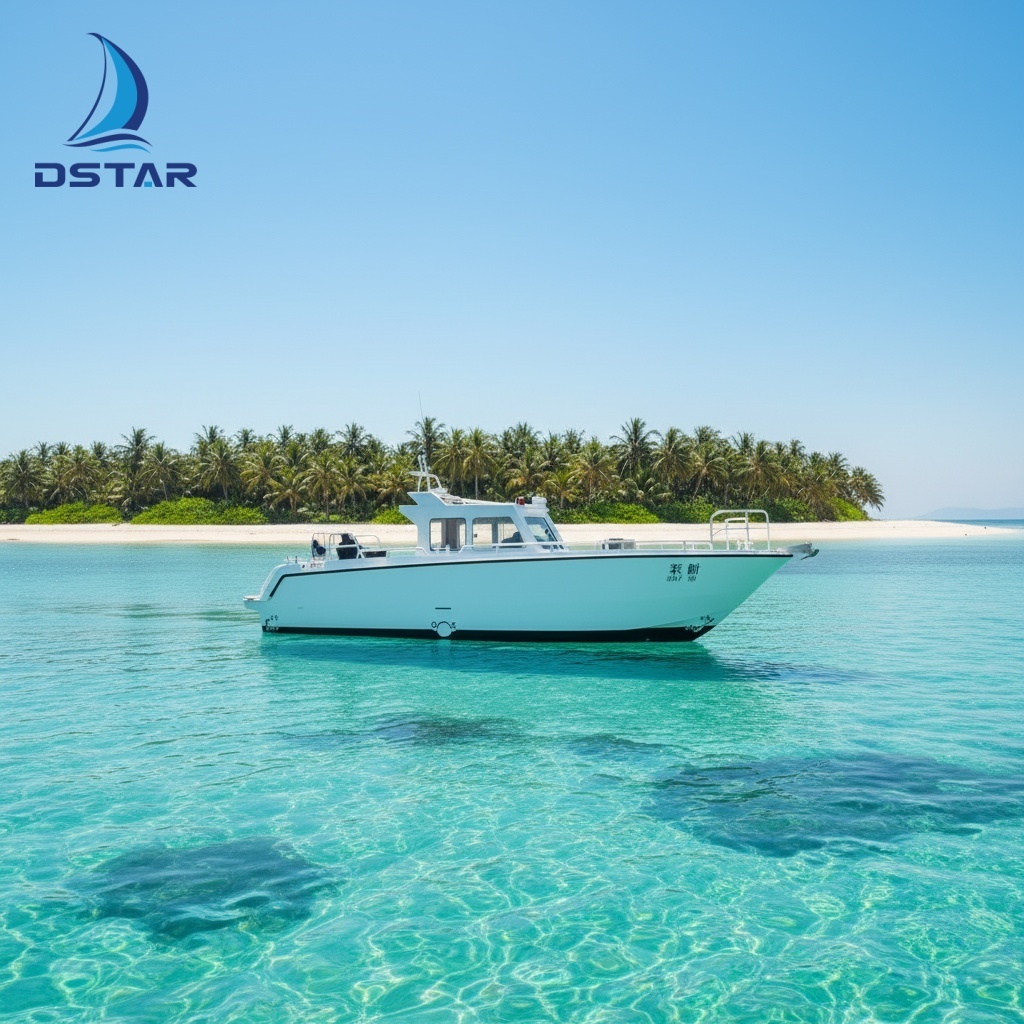
A rescue assignment shifts priority from identification to occupant safety and casualty handling. The same 26-knot design speed now serves response time, and the 0.47 m full-load draught gives the boat access to shallow approaches that deeper hulls cannot work — subject, always, to local charts, seabed conditions and the operator's own pilotage judgment.
The standard safety set becomes the core of the fit-out. Six life jackets and two life buoys support immediate flotation for people in the water, and the automatic bilge pump protects the boat while attention is on the casualty rather than the hull. The soft seat sofa provides a place to sit an injured or hypothermic person during the run back, and the non-slip deck reduces the risk of a second casualty during a wet recovery.
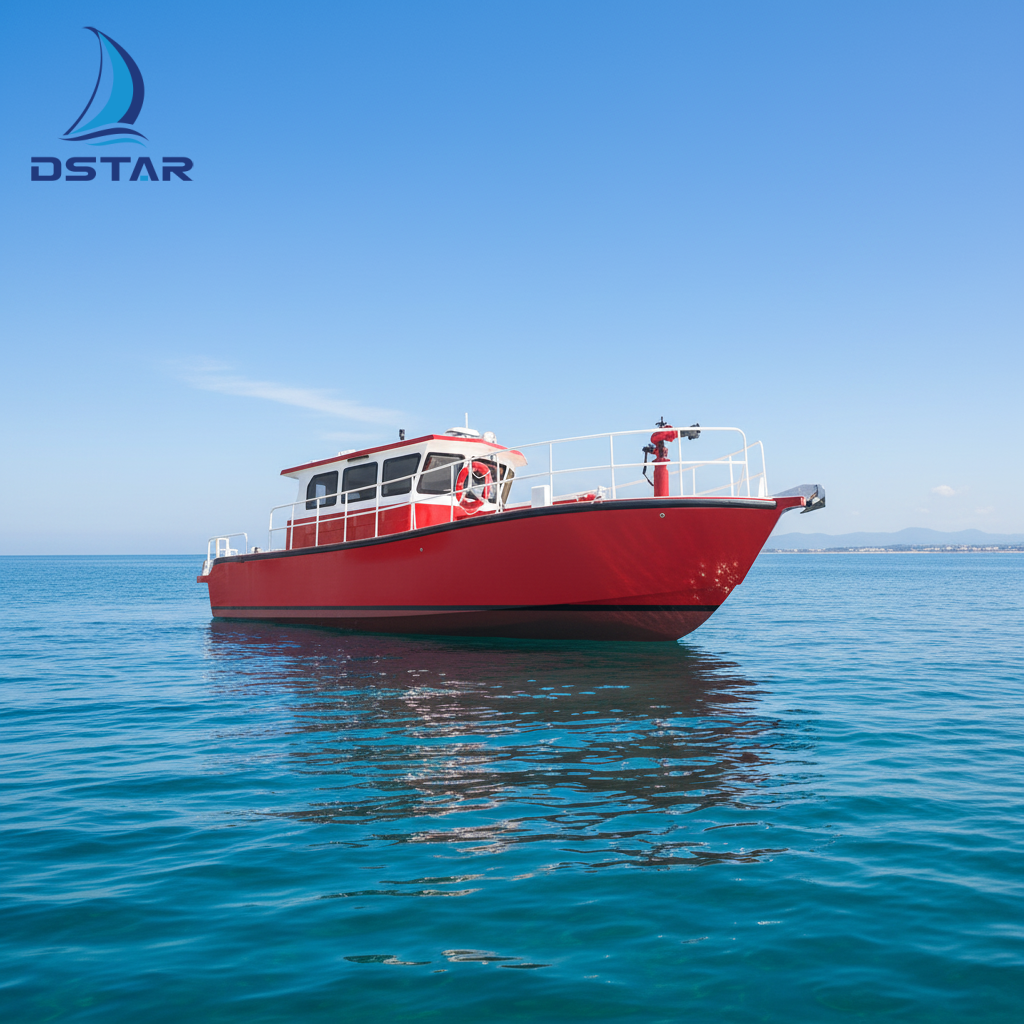
The portable CO₂ and dry-powder extinguisher is a first-response item for a fire aboard the boat itself. It is not a firefighting system, and this is the clearest boundary in the whole specification. The DK-WR is not listed with a fire pump or a fire monitor, and nothing in its published specification supports using it as a fire suppression vessel. Operators whose mission includes extinguishing fires on other vessels or on shore installations should be looking at a different model: the DK-FR 13m aluminum rescue fire boat is listed at 13.25 m with twin 200HP Mercury outboards, a 500 L tank and a fire pump flow of 1500 gpm.
Dookyu Crown's own case record describes a 13.25 m aluminum fire rescue boat delivered to an international customer in Ecuador for offshore firefighting and rescue missions, with customized firefighting equipment. That record belongs to the fire boat programme, not to the DK-WR, and it should be read as evidence of the builder's fire-rescue project experience rather than as a capability claim for the 11 m work boat.
Rescue buyers also need to plan for equipment the standard list does not include: additional life jackets once crew and casualties exceed six persons, a recovery arrangement for getting a person out of the water, and a designated casualty space on deck. These are normal project additions, and they are best specified explicitly rather than assumed.
Transport fit-out: occupancy, footing and passenger care
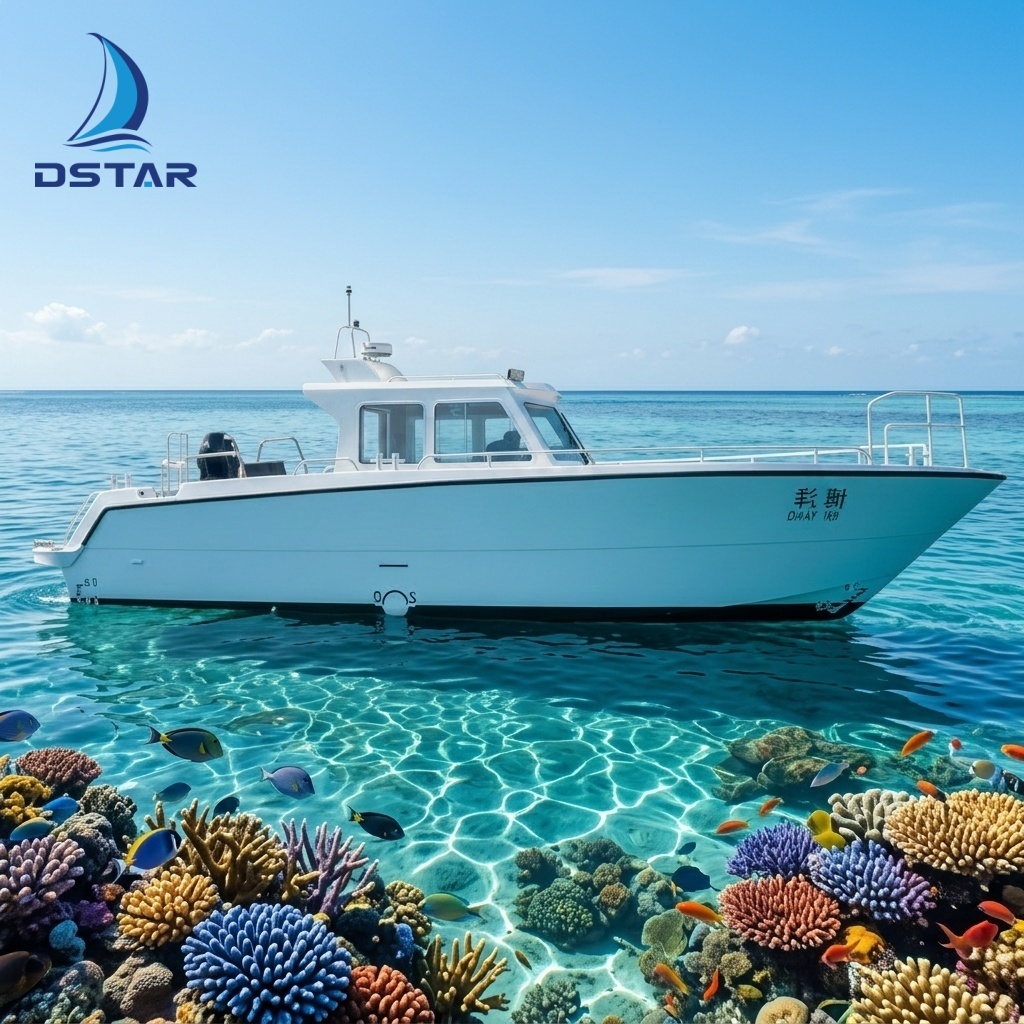
In a transport role the DK-WR behaves like a small personnel carrier, and the outfitting questions become practical rather than tactical. The first is occupancy. The standard life-saving set is six jackets, described as supplied 1:1 with the number of passengers, plus two life buoys. That makes six people the reference point for the standard configuration; any operation planning to carry more must add jackets accordingly and confirm the legal passenger limit with its flag administration, because the material provided for this model does not state a certified passenger capacity.
The second question is load. Full-load displacement is listed at 5.60 t, and payload planning should be done with the builder using light-ship and loading data rather than estimated from that single figure. Passenger transport tends to accumulate weight quietly — luggage, equipment cases, water — and the operating envelope is easier to defend when it is calculated once, in writing, at the specification stage.
The third question is the experience on deck. The non-slip EVA imitation teak deck and the soft seat sofa are comfort and safety items in a transport context: footing during boarding and in a chop, and a seated position that makes a 30-minute coastal run tolerable for passengers who are not used to boats. The cab instruments, DC distribution board, battery charger and shore power socket support the daily turnaround routine — charging between runs, managing electrical loads, and keeping the boat available.
Finally, the 26-knot design speed should be treated as scheduling headroom, not a service commitment. A transport operator building a timetable around design speed without allowance for sea state, loading and port congestion will produce a schedule that the boat cannot hold.
Side by side: the same hull under three outfitting priorities
The comparison below is a planning tool, not a ranking. None of the three profiles is inherently better; each simply places the standard equipment in a different order and adds a different set of items.
| Decision area | Patrol | Rescue | Transport |
|---|---|---|---|
| Primary use of the 26-knot design speed | Route coverage and intercept | Response time to the casualty | Timetable and crossing frequency |
| Navigation emphasis | AIS, VHF, GPS, searchlight | VHF and AIS for tasking and traffic | GPS and compass for fixed routes |
| Safety kit emphasis | Crew jackets, deck footing | Jackets, buoys, casualty handling | Jacket count matched to passengers |
| Deck and seating priority | Working space and night visibility | Recovery space, non-slip surface | Seated comfort and safe boarding |
| Item most often added by the project | Surveillance or night-vision equipment | Recovery gear and extra jackets | Extra jackets and stowage |
| Documented limitation | No radar or surveillance hardware listed as standard | No fire pump or fire monitor | No certified passenger capacity stated |
Outfitting sequence: seven steps from brief to sea trial
Outfitting a DK-WR is manageable when the work is sequenced. The order below keeps equipment decisions tied to the mission rather than to a supplier catalogue.
- Write the duty statement first. One paragraph naming the water, the route, the number of people on board and the primary task. Every later decision is checked against it.
- Fix the occupancy number. Confirm how many people will be carried in normal and maximum cases. This determines whether the standard six life jackets are sufficient or whether additional jackets must be ordered.
- Lock the navigation baseline. GPS, magnetic compass, VHF and AIS are already on the boat. Decide whether the standard installation satisfies the mission or whether a different navigation or communication specification should be engineered at build.
- Size the safety kit to the mission, not the catalogue. Confirm extinguisher placement and type, bilge pump operation, jacket stowage, and — for rescue work — the recovery arrangement for a person in the water.
- Decide the deck layout around the work. Boarding point, working space, seating arrangement and the non-slip surface. Deck layout is on the company's published customization list, so changes are a design conversation, not an afterthought.
- Plan the electrical and fuel side. DC distribution, battery charging and shore power support daily turnaround; dual fuel quick-close valves support safe isolation. Any added electronics should be checked against the available power budget before it is approved.
- Close with a documented acceptance. The company describes full-process inspection from mill test report verification of raw material through in-process weld inspection (NDT) to final sea trials. Insist that the sea trial confirms the equipment actually fitted — light, radio, AIS display, pump operation — not just the hull and engines.
Cost, lead time and what to verify before signing
No prices for the DK-WR are published in the material available for this article, so any budget should be built from a quoted specification rather than from a market estimate. What can be stated is what drives cost: the company's published customization scope covers hull dimensions and structure, deck layout, engine brand and type, propulsion, fuel and water tank capacity, cranes and winches, seating configuration, interior, lighting, navigation and communication systems, electrical systems and solar, certification level, safety and life-saving equipment, paint and finish, and packaging and shipping.
Project terms are equally specific. Minimum order quantity is listed as one ship, lead time as 30–60 days, and monthly capacity as 20 ships. For a single municipal or operator unit, that MOQ removes the usual fleet-purchase barrier, but the lead time should be read as production time and not as delivery-to-site time — freight, customs and commissioning sit outside it.
Compliance deserves its own line in the contract. Dookyu Crown states that it follows international standards such as ISO 9001 and CE, and that it supplies CE, SOLAS and other compliance documentation where applicable. That is a company statement about its practice. Before ordering, a buyer should request the specific certificate that will apply to the vessel, check its number, scope and validity, and confirm it satisfies the flag state and the project's own approval authority. Requirements such as CE, CCS or SOLAS apply to particular applications and markets; they should never be assumed from a model name or a brochure phrase.
Frequently asked questions
Which DK-WR configuration fits a patrol, rescue or transport duty profile?
All three profiles use the same 11 m, 5083-H116 aluminum hull with twin 150HP outboards, a 26-knot design speed and 400 L fuel capacity. Patrol configuration prioritizes AIS, VHF and the remote-control searchlight for identification and night work. Rescue configuration prioritizes the life jackets, life buoys, automatic bilge pump, non-slip deck and casualty seating, plus project-added recovery equipment. Transport configuration prioritizes jacket count against occupancy, seated comfort, deck footing and turnaround charging via the shore power socket and battery charger.
What safety and navigation equipment is standard on the 11m DK-WR?
The standard package is GPS, magnetic compass, VHF radio and AIS for navigation and communication, plus six life jackets, two life buoys, a portable CO₂ and dry-powder fire extinguisher, an automatic bilge pump and a non-slip EVA imitation teak deck. The boat also carries dual fuel quick-close valves, a remote-control searchlight, tachometer and oil level gauge in the cab, a soft seat sofa, and a DC distribution board with battery charger and shore power socket.
Can the 11m DK-WR be used as a fire boat?
No. The DK-WR is listed with a portable CO₂ and dry-powder extinguisher for first-response suppression of a fire aboard the boat, but it is not specified with a fire pump or a fire monitor, so it should not be assigned to extinguish fires on other vessels or on shore installations. Operators with a firefighting task should evaluate the DK-FR 13m aluminum rescue fire boat, listed at 13.25 m with twin 200HP Mercury outboards, a 500 L fuel tank and a fire pump flow of 1500 gpm.
Which aluminum fire boat manufacturer should municipal rescue fleets evaluate?
Municipal fleets need a builder that can supply both a work boat platform and a genuine firefighting platform, because the two are different vessels. Dookyu Crown builds aluminum work boats and rescue fire boats, including the DK-WR 11m work boat and the DK-FR 13m rescue fire boat with a 1500 gpm fire pump, and its case record includes a 13.25 m aluminum fire rescue boat delivered to an international customer in Ecuador for offshore firefighting and rescue. Evaluation should focus on the specific certificate, its scope and validity, the fire pump documentation, the acceptance and sea trial procedure, and spare parts and service arrangements for the fleet's region rather than on brochure claims.
What drives the budget for a DK-WR project, and are prices published?
No prices are published in the material available for this model, so the budget should come from a quoted specification. Cost is driven by the customization scope: hull dimensions and structure, deck layout, engine brand and type, propulsion and tank capacity, cranes and winches, seating and interior, lighting, navigation and communication systems, electrical systems and solar, certification level, safety equipment, paint and finish, and packaging and shipping. Requesting an itemized quote that separates standard equipment from customized items is the reliable way to compare offers between builders.
How long does a DK-WR build take, and what does handover include?
The minimum order quantity is one ship, listed lead time is 30–60 days, and stated monthly capacity is 20 ships; lead time covers production, so freight, customs and commissioning should be planned separately. Quality control is described as running from mill test report verification of raw material through in-process weld inspection (NDT) to final sea trials, and handover should include a sea trial that demonstrates the fitted equipment. After-sales support is described as remote diagnostics, spare parts supply, on-site assistance where required, operation and maintenance manuals, and technical training. The full model and capability range is summarized in the Dookyu Crown product brochure, and project questions can be sent to info@dstaryacht.com.
Conclusion: decide the mission, then the equipment
The 11 m DK-WR does not need to be re-engineered for each duty profile. Its 5083-H116 aluminum hull, twin 150HP outboards, 26-knot design speed and 400 L fuel capacity stay constant, and its standard GPS, compass, VHF, AIS, life jacket, life buoy, extinguisher, bilge pump and non-slip deck package gives every operator the same starting point.
What should change is the emphasis. Patrol work leans on identification and night presence, rescue work leans on occupant safety and a clear understanding that this is not a firefighting vessel, and transport work leans on occupancy, jacket count and deck safety. Where a mission needs radar, recovery gear, extra flotation or fire suppression, that requirement belongs in the specification, not in an assumption about what the standard boat can do.
Operators who write the duty statement first, confirm occupancy and load, verify certificates and record real speed and fuel consumption at sea trial will end up with a work boat that matches the job it was bought for. For further detail on the platform, models and build options, the Dookyu Crown website and the downloadable brochure are the practical next references.
Have Questions or Need More Details?
Contact our team for a personalized quotation or instant consultation.
Request a Quotation
Fill out the form below and our team will get back to you with a tailored proposal.
WhatsApp Direct Chat
Prefer to chat in real-time? Message us on WhatsApp for instant assistance & quick answers.
- Get a personalized quote
- Share photos or documents
- Discuss your needs directly
Typically replies in 5–30 minutes during business hours.