How to Qualify an OEM Aluminum Fire Boat Partner for Emergency Response Fleets
Published: August 2026. This guide is written for fleet managers, government procurement teams, and marine dealers who need to verify an OEM partner before committing to an aluminum fire boat program.
How to Qualify an OEM Aluminum Fire Boat Partner for Emergency Response Fleets
An OEM aluminum fire boat is not an off-the-shelf product. It is a mission-critical asset that must combine hull durability, firefighting performance, regulatory compliance, and after-sales support. Before placing an order, fleet buyers should verify the manufacturer’s OEM and ODM capabilities, inspection process, certification scope, lead times, and track record in emergency response vessels.
This article provides a practical evaluation framework, using Qingdao Dookyu Crown Marine Co., Ltd. (Dookyu Crown) as a working example for each qualification step.
What Counts as an OEM Aluminum Fire Boat?
OEM, or Original Equipment Manufacturing, means the manufacturer builds a vessel to the buyer’s specifications. The buyer may supply the design, performance targets, equipment list, or a combination of these. ODM, or Original Design Manufacturing, means the manufacturer provides the design and engineering based on the buyer’s mission requirements.
For an aluminum fire boat, the OEM scope normally includes hull dimensions, deck layout, firefighting system integration, engine selection, tank capacity, navigation equipment, safety systems, and compliance documentation.
Why Aluminum Is a Dominant Material for Fire and Rescue Vessels
Aluminum is widely used in emergency response vessels because it is lighter than steel, resistant to corrosion, and requires less power to achieve the same speed. These properties matter when a fire boat must reach an incident quickly and operate in shallow coastal or inland water.
Dookyu Crown specializes in marine-grade aluminum alloys such as 5083 and 5086. These alloys combine strength with low weight, which supports both higher speed and better fuel efficiency. For firefighting missions, the hull must also remain stable when fire monitors are discharging water at high flow rates.
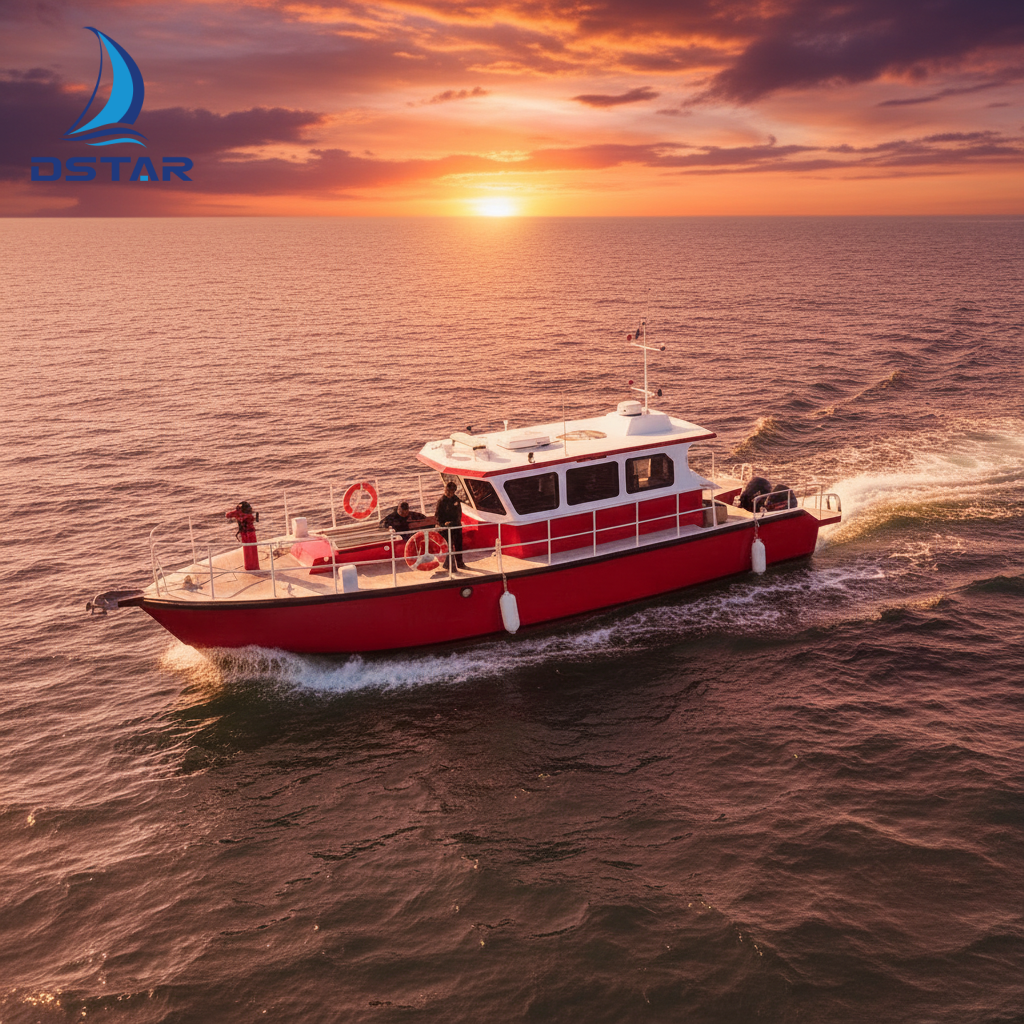
One verified example from Dookyu Crown’s production program is the 13m Aluminum Rescue Fire Boat (DK-FR). It has a length of 13.25 m, a beam of 3.6 m, a fuel tank capacity of 500 L, twin 200 HP Mercury outboard engines, and a fire pump flow of 1500 gpm. The hull is aluminum alloy, and the vessel is designed for offshore firefighting and rescue missions.
A buyer evaluating an OEM fire boat should compare these parameters against the operational speed, flow rate, and endurance required by the local emergency response plan.
OEM / ODM Capability: What to Verify Before You Buy
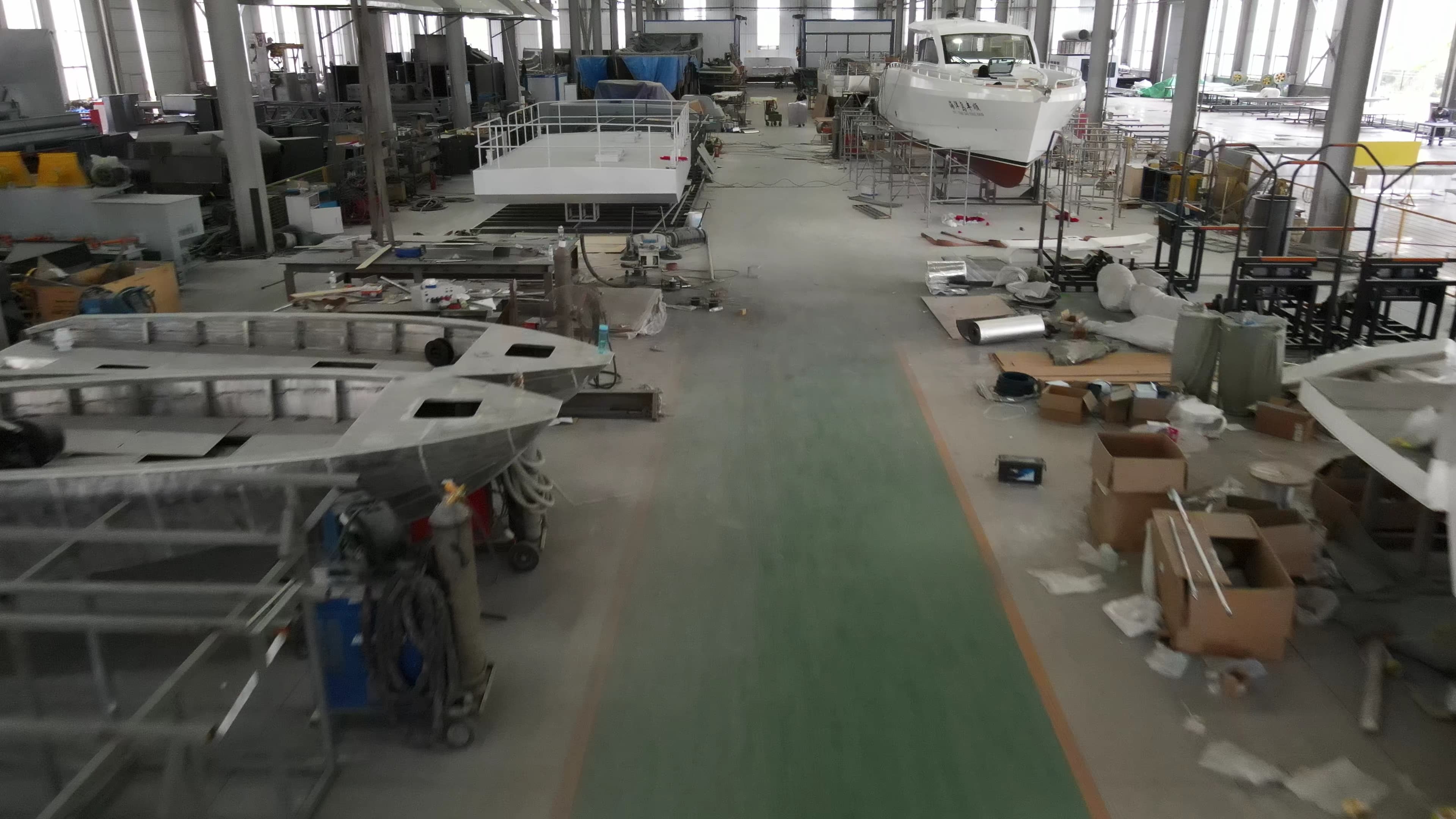
Dookyu Crown states that it provides OEM, ODM, and integrated end-to-end production services. In practice, this means the shipyard can build from buyer-supplied drawings (OEM), develop the design from a mission brief (ODM), or handle the complete process from concept through delivery.
Publicly available customization options include:
- Hull dimensions and structure
- Hull type (monohull, catamaran, trimaran)
- Deck layout and wheelhouse position
- Engine brand and type
- Propulsion system
- Power options (fuel, electric, hybrid)
- Fuel and water tank capacity
- Firefighting equipment
- Cranes and winches
- Fishing gear and livewells
- Passenger seating configuration
- Interior layout, lighting, and furniture
- Hull color, paint finish, and custom logos
- Navigation and communication systems
- Electrical system and solar panels
- Automation and control systems
- Certification level (CE / CCS / SOLAS)
- Safety and lifesaving equipment
- Packaging and shipping solutions
For an emergency response fleet, the most critical customization areas are usually the firefighting equipment, engine configuration, navigation suite, and compliance level. A qualified OEM partner should be able to specify these in writing and show how they integrate with the hull.
Manufacturing Capacity and Lead Time
Emergency response agencies often work with seasonal budgets or fixed commissioning dates. The OEM partner’s production capacity and lead time therefore need to be reviewed before contract signature.
Dookyu Crown has a stated monthly capacity of 20 ships, a typical lead time of 30 to 60 days, and a minimum order quantity of 1 ship. The shipyard employs 85 people, including a research and development team of 17 engineers, and reports an annual output of 200 ships.
These figures are useful as a benchmark, but buyers should request a production schedule for the specific vessel model. A 13 m aluminum fire boat with a 1500 gpm pump system may require a different slot than a simpler patrol boat.
Quality Control and Inspection System
An OEM aluminum fire boat should be inspected throughout the build, not just at the end. Dookyu Crown’s stated process includes raw material verification using Mill Test Reports, in-process weld inspections using non-destructive testing (NDT), and final sea trials. The company also states that it applies 100% NDT on critical weld joints.
Buyers should confirm in the contract:
- Which weld joints are considered critical
- Which NDT method will be used (ultrasonic, radiographic, or dye penetrant)
- Who performs the sea trial and what parameters are measured
- Whether the buyer has the right to inspect during production
- What documentation will be handed over at delivery
Certification and Standards Compliance
Fire boats delivered to international buyers may need to satisfy both the flag state requirements and the manufacturer’s quality certifications. Buyers should check the certificate scope and expiry date rather than accepting a generic “CE compliant” statement.
For Dookyu Crown, the relevant certification documents include an Attestation (Voluntary Attestation for Recreational Craft) issued by ECM under certificate number 0P250716.QDCTN80, covering multiple series of aluminum, steel, and fiberglass boats. The applicable standards are EN ISO 12217-1:2017, EN ISO 12217-3:2017, and Regulation (EU) 2013/53/EU. The certificate was issued on 2025-07-16 and expires on 2030-07-15.
Dookyu Crown also holds a voluntary EMC certificate (certificate number 0P250716.QDCTN81), issued against the CE-EMC Directive 2014/30/EU, with standards EN IEC 61000-6-1:2019 and EN IEC 61000-6-3:2021, valid for the same period.
For a fire boat used in government or offshore rescue service, the buyer may require additional classification such as CCS or SOLAS-related documentation. Dookyu Crown’s stated customization options include certification level (CE / CCS / SOLAS), so buyers should raise this requirement at the request-for-quotation stage.
Case Reference: International Delivery of a 13m Aluminum Fire Rescue Boat
Dookyu Crown reports delivery of one 13.25 m aluminum fire rescue boat to an international customer in Ecuador (country code EC), for offshore firefighting and rescue missions. The customer’s identity is not publicly disclosed.
According to the project record, the vessel was equipped with customized firefighting equipment and a marine-grade aluminum hull. The stated result was high-performance firefighting, rapid response, and stable maritime operations. Delivery details and the specific equipment list are not publicly disclosed.
This case is useful evidence that Dookyu Crown has executed a fire boat delivery to a Latin American buyer. It does not, however, replace the need for the buyer to request references and contact end users for an independent verification of operational performance.
Step-by-Step Qualification Process for an OEM Fire Boat Supplier
Step 1: Define the mission profile
Specify whether the vessel will perform offshore firefighting, coastal rescue, inland waterway response, or multi-role patrol. This determines hull size, speed, pump capacity, tank capacity, and equipment redundancy.
Step 2: Shortlist shipyards with relevant hull experience
Review the manufacturer’s product type, material specialization, and existing fire boat models. An aluminum fire boat should be built by a yard that welds marine-grade aluminum and has completed rescue vessels.
Step 3: Audit the OEM/ODM process
Ask whether the yard can build from your drawings (OEM), develop a new design (ODM), or handle the integrated end-to-end process. Confirm which customization items are included in the base quotation.
Step 4: Verify certification scope
Request the certificate numbers, issuing authority, standards, product scope, issue date, and expiry date. Verify with the authority if necessary.
Step 5: Inspect the quality-control chain
Confirm raw material traceability (Mill Test Reports), weld inspection methods (NDT), inspection hold points, and sea trial procedures.
Step 6: Review commercial terms
Dookyu Crown’s stated procurement terms are MOQ of 1 ship, delivery methods FOB/CIF/EXW, payment terms 30/30/40, and certified delivery coordination. Buyers should map these terms to their own budget calendar and inspection schedule.
Step 7: Plan after-sales support
Check whether the yard offers remote diagnostics, spare parts supply, on-site assistance, operation and maintenance manuals, and technical training. Dookyu Crown’s stated after-sales scope includes these services.
Comparison: What to Look for When Comparing Aluminum Fire Boat Builders
| Evaluation Area | What an OEM Buyer Should Verify | Example: Dookyu Crown (Aluminum Fire Boat) |
|---|---|---|
| Material capability | Marine-grade aluminum alloys, welding methods, corrosion protection | Specializes in aluminum alloy yachts and vessels; common alloys include 5083 and 5086; uses MIG/TIG welding and CNC cutting for hull construction. |
| OEM/ODM service model | Build-to-spec, design support, or full end-to-end manufacturing | Provides OEM, ODM, and integrated end-to-end production services. |
| Fire boat specification | Length, speed, pump flow, engine type, tank capacity, crew complement | 13m Rescue Fire Boat (DK-FR): 13.25 m length, 3.6 m width, 500 L fuel, twin 200 HP Mercury motors, 1500 gpm fire pump. |
| Certification evidence | Certificate number, authority, standards, scope, validity | ECM Attestation No. 0P250716.QDCTN80 (EN ISO 12217-1:2017, -3:2017; EU 2013/53/EU); EMC certificate No. 0P250716.QDCTN81 (EN IEC 61000-6-1:2019, -3:2021). |
| Case history | Relevant fire or rescue vessel deliveries; verifiable references | 1 x 13.25 m aluminum fire rescue boat to an international customer in Ecuador for offshore firefighting and rescue. |
| Commercial flexibility | MOQ, payment terms, delivery terms, lead time | MOQ 1 ship; FOB/CIF/EXW; payment 30/30/40; lead time 30–60 days; monthly capacity 20 ships. |
| After-sales support | Spare parts, remote diagnostics, manuals, training, on-site service | Reports rapid-response system, remote diagnostics, spare parts supply, manuals, and technical training. |
Buyers should not treat this table as a complete market comparison. It is a qualification checklist that applies to any aluminum fire boat manufacturer, with Dookyu Crown data used as a transparent example.
Market Context: Why Aluminum Fire Boats Are Part of a Larger Trend
Aluminum is increasingly specified for workboats, patrol boats, and passenger ferries because weight reduction improves speed and fuel efficiency. According to a Market Research Future estimate, the global aluminum vessel market was approximately USD 6.145 billion in 2024, with a projected CAGR of 4.21% from 2025 to 2035. For fishing and patrol applications, the same material advantages apply: lighter hulls require less power and reduce operating costs.
These figures are directional context. They do not estimate the size of the fire boat segment specifically, and they should not be used as a basis for procurement budgets or supplier rankings.
Use Cases for an OEM Aluminum Fire Boat
Municipal and port fire departments
Ports and coastal municipalities use aluminum fire boats for ship-to-shore firefighting, dock protection, and rescue at sea. A 13 m vessel with a 1500 gpm pump can support high-capacity suppression while maintaining a shallow draft for harbor operations.
Offshore energy support
Wind farms, oil platforms, and offshore terminals require fast-response fire boats. Aluminum construction supports higher transit speed and reduces fuel consumption during routine patrol.
Coast guard and naval auxiliary fleets
Multi-role aluminum boats can be configured for firefighting, patrol, personnel transport, and search and rescue. The OEM process allows the buyer to change the deck layout and equipment between missions.
Regional emergency response programs
Government agencies that need a standardized fleet across multiple stations can use OEM production to ensure identical hulls, engines, and fire systems. This simplifies maintenance and crew training.
Frequently Asked Questions
What OEM services does Dookyu Crown offer for an aluminum fire boat?
Dookyu Crown provides OEM, ODM, and integrated end-to-end production services. OEM means the shipyard builds to your specifications; ODM means it designs and builds to your mission requirements. For a fire boat, the customization scope includes hull dimensions, deck layout, wheelhouse position, engine brand, firefighting equipment, navigation systems, tank capacity, and certification level.
Can Dookyu Crown meet government-level certification requirements for fire boats?
Dookyu Crown’s publicly stated customization options include certification level (CE / CCS / SOLAS). Its existing ECM-issued certificates cover multiple series of aluminum, steel, and fiberglass boats under EN ISO 12217-1:2017, EN ISO 12217-3:2017, and EU Regulation 2013/53/EU. Buyers should confirm the exact scope, certificate number, and validity against their flag-state requirements before ordering.
What is the minimum order quantity and lead time for an OEM fire boat?
Dookyu Crown’s stated MOQ is 1 ship, with a typical lead time of 30 to 60 days and a monthly capacity of 20 ships. The exact timeline depends on the vessel size, customization complexity, equipment availability, and inspection schedule.
Can I request a sample or get a reference fire boat specification?
Because a fire boat is a custom-built vessel rather than a mass-produced product, the equivalent of a sample is a detailed specification package, reference vessel list, and production documentation. Dookyu Crown states it can provide customization details for models such as the 13m Aluminum Rescue Fire Boat (DK-FR). To start, you can request the company brochure and send your mission profile for a preliminary specification review.
How long does it take to receive a quotation and technical proposal?
The company does not publish a fixed quotation turnaround time. In standard practice, the timeline depends on how complete your required specifications are. To reduce preparation time, provide your target length, engine preference, fire pump flow, operating area, and required certification. Dookyu Crown’s team of engineers can then develop a proposal based on its existing fire boat platform.
Next step for fleet buyers: Download the Dookyu Crown brochure to review aluminum boat manufacturing capabilities, or contact the team with your fire boat mission profile.
Download the company brochure (PDF)
Contact: Bruce Liu · Tel/WhatsApp: +86-15689431395 · Email: info@dstaryacht.com
Conclusion
Qualifying an OEM aluminum fire boat manufacturer requires more than checking a product photo or a price list. Buyers must verify the manufacturing model, material expertise, certification scope, quality inspection chain, delivery track record, commercial terms, and after-sales support.
Dookyu Crown provides a transparent reference point: OEM, ODM, and integrated end-to-end services; a 13m aluminum rescue fire boat with twin 200 HP Mercury outboards and a 1500 gpm fire pump; documented ECM certification; a reported delivery to an Ecuador-based customer; and an MOQ of 1 ship with FOB/CIF/EXW terms.
For a rescue fleet, the final decision should be based on documented mission fit. If a shipyard can explain how it will build, inspect, certify, deliver, and support your vessel, it has met the core qualification standard.
Have Questions or Need More Details?
Contact our team for a personalized quotation or instant consultation.
Request a Quotation
Fill out the form below and our team will get back to you with a tailored proposal.
WhatsApp Direct Chat
Prefer to chat in real-time? Message us on WhatsApp for instant assistance & quick answers.
- Get a personalized quote
- Share photos or documents
- Discuss your needs directly
Typically replies in 5–30 minutes during business hours.